A revelation? The term is not an exaggeration. Michael Thalheimer’s staging offers a striking sobriety, stripping the work of all superfluous artifice to leave room for the pure essence of Wagnerian tragedy. The bodies of Tristan and Isolde, separated by several meters when an embrace could bring them together, amplify the tension, reinforced by a masterfully conceived play of shadows. The spectacular arrival of Brangäne, descending from the top of the Grand Théâtre midway through the piece, adds a touch of mystery. She takes the audience by surprise, almost caressing the ears and making us wobble. Her voice fills the space with a benevolent wave, unexpectedly comforting Isolde. A scenic find, you say? Yes, the staging is full of tricks, offering the characters new postures. Brangäne’s beatitude marks a break in this five-hour opera, including intermissions.

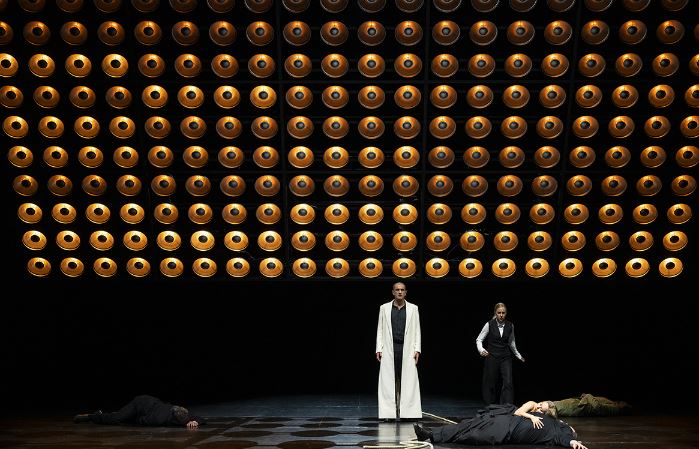
The presence of Tristan, Isolde and the other characters is sublimated in a minimalist but effective set, where Henrik Ahr’s “luminous donut” serves as a metaphor for temporality and the inexorable passage of time. Light and shadows keep watch, like naturalistic elements, overturning a fluid but rising staging. We find ourselves melting for the voices of Gwyn Hughes Jones and Elisabet Strid, although they fall slightly short of the power expected by seasoned aficionados of Wagner’s operas. Love is omnipresent, diffused in small, almost lethal doses. Pallid hues evolve into intense orange-reds that strike the retinas in climactic moments. We praise the inventiveness of the production, and hope that the OSR continues to maintain this density.
We won’t be disappointed: although Gwyn Hughes Jones spends much of the time on the ground, his voice remains powerful and sublimates the text. The grandiloquent encounters between King Marke and Tristan highlight Tareq Nazmi’s exceptional performance as King Marke. His long, imposing figure and powerful, heart-rending voice underline the nobility betrayed by Tristan and Isolde. Dressed in a long white tunic designed by Michaela Barth, Marke evokes both a legendary ruler and a futuristic figure worthy of The Matrix, embodying a scorned purity that further accentuates the tragedy unfolding before our eyes. Under the musical direction of Marc Albrecht, the Grand Théâtre Chorus and the OSR perform a beautiful score. Albrecht brings out the power of Wagner’s music with a rare intensity, but without ever going overboard. Every nuance is perfectly measured, and every crescendo adds a surge of power that makes the hall vibrate. The tableaux follow one another fluidly, without haste, creating a spellbinding rhythm in which the climaxes at the end of the acts resonate with redoubled force. The famous love potion seems to have an effect on the audience itself, caught up in the whirlwind of musical emotions.
A Matrix whose honor has been scorned
Thalheimer’s minimalist staging, in contrast to the intensity of the music, lends the opera a rare elegance. The simplicity of gestures and movements reinforces the barely concealed sensuality that permeates every scene. The alternation between sparing gestures and moments of dramatic intensity creates a captivating, almost hypnotic effect. Movements of anger, dismay and violence arrive unhurriedly, as if slightly detached, the scene in which the glass chalice explodes almost in slow motion being a striking example. Melot’s performance, played by Julien Henric, contrasts with a gentle nervousness that sets him apart from this ballet of perfectly synchronized bodies. The costumes, with Tristan dressed in an ample outfit to match his squire’s modest, gray-black appearance, add to this aesthetic of sobriety and tension.

The audience, initially surprised by this pared-down approach, is quickly swept along by the emotional wave that sweeps through the hall. The orchestra rumbles, but under Albrecht’s direction, it almost never drowns out the voices, which rise through this maelstrom of sound with stunning clarity. Every note, every word is chiseled with precision in Tristan’s mouth, highlighting the thunderbolts of feeling that strike the characters. The atmosphere of despair gradually settles in, punctuated by moments of singing of vibrant intensity. A special mention must go to Isolde, whose performance combines obvious grace with theatrical sobriety. Her restrained tenderness provides a delightful counterpoint to her acting.
After almost five hours of performance, the Geneva audience gave a well-deserved standing ovation. With this minimalist yet powerful vision, the Grand Théâtre de Genève confirms its position as one of the world’s great stages capable of sublimating Wagner’s work. In this hall, the passion is palpable, carried by singers and musicians who give themselves body and soul, making this opera deeply seductive and memorable. The emotional imprint left on an audience dazzled by love is undeniable.
David Glaser and Franziska Rausch
informations : Grand Théâtre Genève – https://www.gtg.ch/
Thanks to the GTG team and more particularly Karin Kotsoglou
Photos, copyright GTG

 Suississimo